




Remote patient monitoring (RPM) can help clinicians track patients between office visits, but the billing process requires more than collecting readings from a connected device. Is the patient’s condition appropriate for monitoring? Can your team prove that the device transmitted the required data? Are clinical staff recording their time accurately enough to support the service billed?
These questions affect whether a remote patient monitoring (RPM) claim is supported by the clinical record. Practices need to establish medical necessity, follow applicable consent requirements, verify qualifying device and data-transmission criteria, and document treatment-management work accurately. Understanding the requirements for each billed service helps your team identify gaps before submitting a claim.
What Are the Remote Patient Monitoring Documentation Requirements?
RPM documentation should demonstrate why monitoring is appropriate for the patient, what equipment and data are involved, what services the clinical team performed, and how the record supports the code submitted.
The core documentation elements
| Documentation element | What the record should establish |
| Medical necessity | Why the patient’s condition requires monitoring and how the data can inform care. |
| Patient eligibility | That the patient meets the applicable payer and service requirements. |
| Consent | That the patient agreed to participate, with the consent recorded as required. |
| Device information | The device used and its suitability for the monitoring service. |
| Data transmission | Evidence that qualifying physiological data were electronically collected and transmitted. |
| Setup and education | The applicable setup and patient training activities, when billed. |
| Clinical time | The date, activity, person performing the work, and qualifying time where time-based billing applies. |
| Treatment management | The clinical review, decisions, follow-up, and required patient or caregiver communication. |
A complete record does not need to be unnecessarily long. It needs to establish the relevant facts clearly enough that another qualified reviewer can understand what was done and why the claim is appropriate.
1. Establish Medical Necessity Before Starting RPM
RPM should serve a clinical purpose, not just generate a stream of measurements. The clinician should determine whether the patient’s condition warrants remote monitoring and how the resulting information will contribute to treatment or management.
What should the medical necessity note include?
The record should identify:
- The relevant diagnosis or clinical condition.
- Why the physiological parameter needs to be monitored.
- How the information may affect clinical assessment or management.
- The monitoring plan and any relevant instructions.
- The clinician’s review and response to meaningful findings, as applicable.
Clinical necessity criteria for CPM and RPM
RPM and other monitoring or care-management services may have different eligibility and documentation requirements. The abbreviation CPM can refer to different services and should not be treated as a universal Medicare billing category. If your organization uses CPM to describe another program, verify that program’s specific coverage criteria, coding requirements, and documentation standards before billing.
Do not assume that meeting RPM requirements automatically establishes eligibility for a separate service.
2. Follow Patient Consent Rules for Remote Physiological Monitoring
Patients should understand what monitoring involves before participating. Consent supports informed participation and helps establish that the patient agreed to receive the service.
For Medicare, CMS clarified in its RPM policy guidance that consent may be obtained when RPM services are furnished. Practices should still follow the applicable requirements for the payer, service, and date of care.
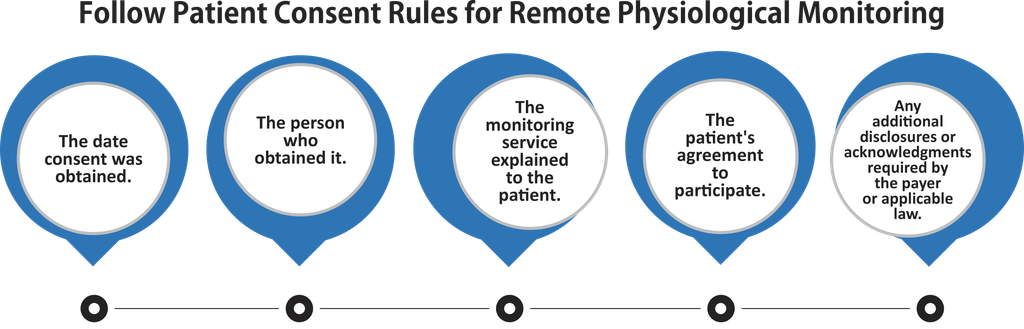
What should the consent record contain?
Use a consistent process to record the consent information required by the applicable policy. A useful record may identify:
- The date consent was obtained.
- The person who obtained it.
- The monitoring service explained to the patient.
- The patient’s agreement to participate.
- Any additional disclosures or acknowledgments required by the payer or applicable law.
3. Verify the Device and Data Transmission Process
A patient can own a device that records physiological readings without necessarily meeting every requirement for a billable RPM service.
Medicare’s RPM policy identifies requirements related to medical devices and electronic data collection and transmission. CMS has clarified that qualifying data must be electronically collected and transmitted rather than relying solely on patient self-reporting.
Review the applicable CMS RPM policy guidance before establishing the monitoring workflow.
What should your team verify?
Device suitability: Confirm that the device meets the applicable requirements for the service and physiological parameter being monitored.
Patient setup: Record relevant setup and education activities when required for the code billed.
Data transmission: Confirm that readings are transmitted through the qualifying process rather than relying exclusively on a patient manually reporting values.
Data availability: Keep records that allow the practice to establish which readings were received and when.
Clinical review: Document relevant interpretation, treatment decisions, and follow-up performed by the clinical team.
A device that is connected to the patient’s phone does not, by itself, establish that all billing criteria have been met. The workflow must support the service actually reported.
4. How to Track 20 Minutes for RPM Billing
RPM treatment-management billing requires an accurate record of qualifying work performed during the calendar month. The time log should identify the activity, date, person performing the work, actual duration, and supporting clinical record.
Under the established Medicare RPM code structure, CPT 99457 generally represents the first 20 minutes of qualifying RPM treatment management in a calendar month, with the required interactive communication. CPT 99458 represents each additional 20 minutes when the applicable requirements are met.
The 2026 code set also includes CPT 99470 for a shorter treatment-management interval. Code selection should follow the current code descriptors, payer policy, and applicable coding edits rather than relying on a single threshold for every patient.
A practical method for tracking RPM time
Use a monthly log that records each qualifying activity as it occurs.
| Date | Activity | Staff member | Time spent | Supporting record |
| October 5 | Reviewed transmitted blood pressure readings and documented findings | Qualified clinical staff | 6 minutes | Monitoring note |
| October 12 | Reviewed trends and prepared a patient-specific follow-up | Qualified clinical staff | 7 minutes | Clinical review |
| October 19 | Conducted qualifying interactive communication with the patient | Qualified clinical staff | 8 minutes | Communication note |
| October 26 | Reviewed new readings and documented the clinical response | Qualified clinical staff | 5 minutes | Monitoring note |
These entries total 26 minutes of recorded activity. They are an illustration of time logging, not a guarantee that all 26 minutes are billable. Each activity must qualify under the code’s rules, and any required communication must be supported by the record.
What belongs in an RPM time log?
Record the date, nature of the work, person performing it, actual time, and relevant clinical outcome. Where required, also document the interactive communication and the resulting clinical action. Avoid these common mistakes:
- Recording a rounded monthly estimate instead of actual qualifying time.
- Counting time spent on unrelated administrative work.
- Counting the same minutes toward multiple services when prohibited.
- Adding time that was not actually spent performing the documented work.
- Treating automated alerts or device-generated reports as proof that a clinician performed treatment management.
Time should be recorded consistently and contemporaneously, rather than reconstructed from memory at the end of the month.
5. Understand the 2026 RPM Code Changes
Practices should not rely exclusively on older RPM billing guides. The 2026 code set includes additional options for certain shorter monitoring periods and treatment-management intervals. Two codes introduced for 2026 are particularly relevant:
| Code | General purpose | Key consideration |
| 99445 | Certain RPM device-supply services involving 2–15 days in a 30-day period | Confirm the applicable device, data, and code requirements. |
| 99470 | A shorter RPM treatment-management time interval | Verify the required time, communication, and other code criteria. |
The established code family also includes 99453 for setup and education, 99454 for qualifying device supply and data collection, 99457 for treatment management, and 99458 for additional treatment-management time.
Why do the new shorter intervals matter?
Monitoring periods and treatment-management time are different concepts. A patient may transmit qualifying readings over a shorter period, while the clinical team may spend a different amount of time reviewing information and managing care.
Your billing workflow should distinguish between:
- The number of days with qualifying data.
- The service associated with supplying the device.
- The time spent performing qualifying treatment-management work.
- Any required interactive communication.
- Other service-specific requirements and payer edits.
6. Document Clinical Review and Patient Communication
RPM documentation should show what the clinical team did with the transmitted data, not just that readings appeared on a dashboard. When treatment-management services are billed, document the qualifying work and required communication.
What if the patient does not respond?
Record outreach attempts and any subsequent actions accurately. Do not document successful interactive communication if it did not occur. If the selected code requires that communication, confirm the applicable requirements before billing.
7. Common RPM Documentation and Compliance Pitfalls
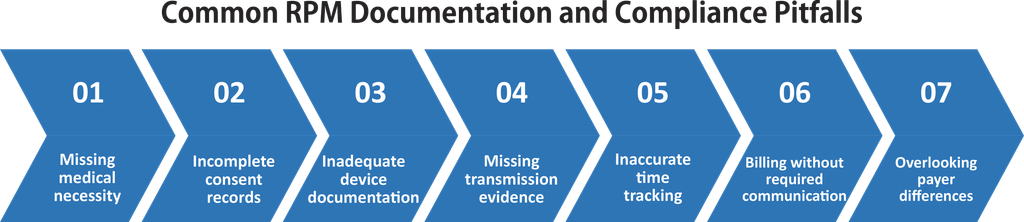
Missing medical necessity
A chart that says only “patient enrolled in RPM” may not adequately explain why monitoring is appropriate. Document the condition, monitored parameter, and clinical purpose.
Incomplete consent records
If the practice cannot establish that the required consent process occurred, the claim may be difficult to support. Make consent capture a defined step in the workflow.
Inadequate device documentation
A device name alone may not establish that the applicable device requirements are satisfied. Keep enough information to support the device and monitoring service billed.
Missing transmission evidence
Patient-reported readings should not be confused with qualifying electronically transmitted data when the applicable Medicare requirements call for automatic collection and transmission. Retain records that support the actual data process.
Inaccurate time tracking
Estimated time, duplicate time entries, and unrelated administrative activities can create compliance concerns. Track qualifying work as it occurs and review the total before billing.
Billing without required communication
If the code requires interactive communication, the note should support that it occurred. Do not assume that reviewing data alone satisfies every treatment-management code.
Overlooking payer differences
Medicare fee-for-service policies do not automatically govern every Medicare Advantage or commercial plan. Check the applicable contract and payer guidance before using a Medicare billing workflow for another payer.
8. Build a Reliable RPM Documentation Workflow
A clear workflow helps the practice identify missing information before the claim reaches the billing team.
At enrollment: Document the clinical rationale, applicable eligibility criteria, and consent.
During setup: Record the setup and education activities required by the code billed.
During monitoring: Retain qualifying transmission records and document relevant clinical review.
During the billing period: Track qualifying time and required communication accurately.
Before submission: Match the code to the actual service and applicable payer rules.
After submission: Review rejections and denials for recurring documentation problems.
This approach helps create a consistent record from enrollment through reimbursement and makes it easier to investigate questions during an audit.
How Med Xpert Services Supports RPM Billing
RPM programs combine clinical documentation, device data, time tracking, coding, and payer-specific billing rules. When those responsibilities are spread across several teams, missing details can be difficult to identify before submission.
Med Xpert Services offers RPM Billing and Coding Services to support RPM coding, claim submission, documentation review, data-transmission checks, time tracking, and denial follow-up.
A structured billing process can help practices identify incomplete records, review code eligibility, and address recurring claim issues. Clinical decisions and the accuracy of the medical record remain the responsibility of the treating professionals and the practice’s established compliance process.
Final Takeaway
Reliable RPM billing depends on matching the medical record to the service actually performed. Practices should document medical necessity, applicable consent, qualifying device and data-transmission requirements, and the clinical work supporting each billed code.
A consistent review process helps identify documentation gaps before claim submission. Because RPM coding and payer policies can change, verify the current code descriptors and applicable Medicare or plan requirements before billing.
Frequently Asked Questions
What are the remote patient monitoring documentation requirements for Medicare?
The record should support medical necessity, applicable patient and consent requirements, the qualifying device and data-transmission process, and any service-specific documentation or time requirements. The exact requirements depend on the code and current Medicare policy.
How do you track 20 minutes for RPM billing?
Record each qualifying treatment-management activity with its date, actual time, staff member, and supporting note. Total the qualifying time for the calendar month, verify any required interactive communication, and select the code that matches the documented service.
Is patient consent required for RPM?
Medicare has specific consent policies for RPM. CMS clarified that consent may be obtained when services are furnished, but practices should verify the current requirements for the payer and service and document consent according to those requirements.
Does RPM data have to be transmitted automatically?
Medicare’s RPM policy specifies electronic collection and transmission of qualifying physiological data rather than relying solely on patient self-reporting. Practices should verify that their device and workflow meet the applicable requirements.
What is the difference between CPT 99453, 99454, 99457, and 99458?
Broadly, these codes address setup and education, qualifying device supply and data collection, initial treatment management, and additional treatment-management time. Code selection must follow the current descriptors and all applicable requirements.
What changed for RPM billing in 2026?
The 2026 code set includes CPT 99445 for certain shorter monitoring periods and CPT 99470 for a shorter treatment-management interval. Practices should review current official code materials and payer guidance before applying these options.
Can a practice bill RPM when a patient submits readings manually?
Manual self-reporting alone does not satisfy Medicare’s requirement for qualifying electronically collected and transmitted RPM data. Confirm the device and data process before billing the applicable service.