The CO-5 denial code means that the procedure code or bill type is inconsistent with the place of service reported on a medical claim. To resolve it, review the Explanation of Benefits (EOB) or Electronic Remittance Advice (ERA), verify the documented service location, check the procedure and claim codes, and follow the payer’s billing requirements. Correct inaccurate claims or appeal when the original claim was submitted correctly.
Key Takeaways
- CO-5 meaning: The procedure code or bill type does not match the reported place of service.
- Common causes: Incorrect POS codes, claim configuration errors, and mismatches between the billed service and its setting.
- How to fix it: Review the remittance advice, verify claim details, and correct the underlying issue before resubmission.
- Appeals: If the claim is accurate, gather supporting documentation and dispute the denial according to the payer’s requirements.
- Prevention: Use claim validation, coding audits, and regular denial trend analysis to identify recurring errors.
What Is the CO-5 Denial Code in Medical Billing?
The CO-5 denial code is a Claim Adjustment Reason Code (CARC) used to explain why a payer adjusted or denied a claim. It indicates that the procedure code or bill type is inconsistent with the place of service reported on the claim.
In medical billing, the place of service (POS) identifies the setting where a healthcare service was provided. For professional claims, POS is generally reported using a two-digit code. The setting can affect whether a service is covered and how the payer processes reimbursement.
For example, a claim may trigger a CO-5 adjustment when the submitted procedure code and reported service location do not meet the payer’s applicable billing requirements.
CO-5 Denial Code Description
The CO-5 denial code description is:
The procedure code or bill type is inconsistent with the place of service.
This means the payer has identified a potential mismatch between the service reported and the setting in which it was performed.
However, the denial does not automatically mean that the provider selected the wrong code. The issue may involve claim data, payer processing, or a misunderstanding of the applicable billing policy.
To verify POS definitions, consult the CMS Place of Service Code Set.
What Does the CO Group Code Mean?
The prefix CO stands for Contractual Obligation. It identifies an adjustment category indicating that the adjustment is generally the provider’s contractual responsibility under the applicable arrangement.
A CO adjustment should not automatically be transferred to the patient. Providers must review the remittance advice, payer contract, applicable law, and claim circumstances before determining patient responsibility.
CO-5 Denial Code vs. Remark Codes
CARCs and Remittance Advice Remark Codes (RARCs) serve different purposes.
| Code type | Purpose |
| CO-5 | Identifies the reason for the claim adjustment or denial. |
| RARC | Provides additional information about the adjustment or explains what information may be needed. |
| Other adjustment codes | May identify separate issues affecting payment on the same claim. |
There is no single RARC that accompanies every CO-5 adjustment. Review the actual ERA or EOB to identify any additional remark codes and follow the instructions associated with that specific claim.
What Are the Common CO-5 Claim Denial Reasons?
Understanding the underlying reason for a CO-5 denial helps billing teams choose the correct resolution instead of repeatedly resubmitting the same claim.
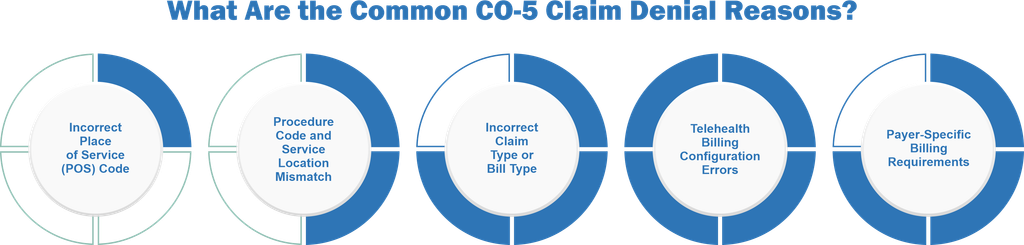
1. Incorrect Place of Service (POS) Code
One common issue is reporting a POS code that does not accurately reflect where the service was performed.
For example, a provider performs a service in a hospital outpatient department, but the claim reports an office POS code. If the reported service and location are inconsistent with the applicable billing requirements, the claim may require correction.
The correct POS must reflect the actual service setting and applicable coding rules.
2. Procedure Code and Service Location Mismatch
Certain procedures have specific coverage, billing, or reporting requirements depending on the setting.
A claim may be flagged when the procedure code, service documentation, and reported POS do not align with the payer’s rules.
Billing staff should confirm that the documented service supports the reported CPT or HCPCS code and that the code is appropriate for the claim circumstances.
3. Incorrect Claim Type or Bill Type
Institutional claims and professional claims use different coding and reporting conventions.
Errors involving the claim format, bill type, or related claim information may create inconsistencies during adjudication.
When investigating this issue, confirm which claim type was submitted and whether the reported information matches the provider’s billing arrangement and the service rendered.
4. Telehealth Billing Configuration Errors
Telehealth claims can require particular POS codes, modifiers, or other claim information, depending on the payer and service.
For instance, CMS distinguishes between POS 02, which applies to telehealth provided other than in the patient’s home, and POS 10, which applies to telehealth provided in the patient’s home.
Incorrectly reporting the location or applying an outdated billing configuration may lead to claim processing problems. Verify the current rules for the specific payer and date of service.
5. Payer-Specific Billing Requirements
Commercial insurers, Medicare, and Medicaid programs may have different billing and reimbursement requirements.
A claim that appears valid under one payer’s policy may be subject to different requirements under another payer’s rules.
Billing teams should review the applicable provider manual, reimbursement policy, and claim-specific instructions before making changes.
How to Fix the CO-5 Denial Code
Resolving a CO-5 denial requires identifying the actual discrepancy and taking the appropriate corrective action.
Step 1: Review the EOB or ERA
Start by reviewing the payer’s remittance advice.
Identify the CO-5 adjustment, any accompanying remark codes, the affected service line, and the amount adjusted. Determine whether the entire claim was denied or only a particular service.
The additional information on the remittance advice can help narrow down the issue.
Step 2: Verify the Documented Place of Service
Check the medical record, appointment details, facility information, and other relevant documentation to confirm where the service was actually performed.
Compare the documented setting with the POS reported on the claim.
Do not change the POS simply to obtain reimbursement. Any correction must accurately reflect the service and comply with applicable billing requirements.
Step 3: Check the CPT/HCPCS Code and Claim Type
Review the procedure code, bill type where applicable, and other relevant claim details.
Confirm that the submitted information is consistent with the service provided, the documentation, and the claim format.
If the procedure code or another claim element is incorrect, determine the appropriate correction based on the applicable coding guidance.
Step 4: Review the Payer’s Billing Policy
Consult the payer’s current billing manual or reimbursement policy for the relevant service, setting, and date of service.
For Medicare professional claims, the CMS Place of Service Code Set provides official POS definitions.
If the claim remains unclear, contact the payer or its provider support team for clarification.
Step 5: Submit a Corrected Claim or Appeal
Choose the next action based on what the review reveals.
- If the original claim contains an error: Correct the inaccurate information and submit a corrected claim according to the payer’s procedures.
- If the original claim was accurate: Consider disputing the denial or filing an appeal with supporting documentation.
- If more information is required: Follow the payer’s instructions for providing the missing details.
Check filing deadlines and submission requirements before proceeding.
Step 6: Track the Claim Until Resolution
Record the correction or appeal, submission date, supporting documentation, and follow-up date.
Monitor the claim until the payer issues a final determination. If the claim remains unresolved, follow up through the payer’s designated channel.
Consistent tracking helps prevent claims from remaining unpaid simply because a corrected submission or appeal was not monitored.
CO-5 Denial Resolution Checklist
Before closing the denial, confirm that:
- The EOB or ERA and any accompanying remark codes have been reviewed.
- The documented place of service has been verified.
- The procedure code and claim information have been checked.
- Applicable payer policies have been reviewed.
- The appropriate correction or appeal has been submitted.
- Follow-up has been documented and completed.
How to Appeal a CO-5 Claim Denial
An appeal may be appropriate when the provider believes the claim was submitted correctly but the payer’s decision does not reflect the documentation or applicable policy.
When Should You Appeal a CO-5 Denial?
Consider an appeal when the reported procedure and place of service are accurate, the documentation supports the claim, and the payer’s denial appears inconsistent with its applicable billing rules.
If the claim contains a genuine coding or data-entry error, correcting the claim may be more appropriate than appealing the original submission.
What Documents Should You Include?
Depending on the payer’s requirements, an appeal may include:
- The original claim and remittance advice.
- Relevant medical records or service documentation.
- Evidence supporting the reported place of service.
- The applicable payer policy or billing guidance.
- A concise explanation of why the denial should be reconsidered.
Submit only the information required to support the dispute and follow the payer’s instructions for protecting patient information.
How Should You Follow the Appeal Timeline?
Review the payer’s appeal policy and submit the appeal within the applicable deadline.
For Original Medicare, providers can consult the CMS Medicare Fee-for-Service Appeals guidance for information about the applicable appeals process.
Commercial insurers and Medicaid programs may have different procedures and deadlines. Keep copies of the submission and monitor the appeal until a decision is issued.
How to Prevent CO-5 Denials
Preventing repeat denials requires more than correcting individual claims. Billing teams should identify why mismatches occur and improve the processes that allow them through.
1. Validate Place of Service Before Submission
Confirm the service location during charge entry and claim review. Ensure the POS accurately reflects where the service occurred and meets the payer’s requirements.
2. Use Automated Claim-Scrubbing Rules
Configure billing software to flag potentially inconsistent procedure codes, POS information, and claim types before submission.
Automated edits should support accurate billing rather than automatically changing claim information without verification.
3. Audit Repeated Denial Patterns
Track CO-5 adjustments by provider, location, procedure, payer, and date of service.
Recurring patterns may indicate an outdated billing rule, an incorrect software configuration, or a training gap.
Regular medical billing and coding audits can help identify these issues and guide corrective action.
4. Train Billing Staff on Payer Policies
Provide regular training on POS coding, claim requirements, telehealth billing, and payer policy updates.
Maintain clear procedures for investigating denials so that staff members follow the same verification and correction process.
5. Monitor Denial Trends and Corrective Actions
Track the number of CO-5 adjustments, common root causes, resolution outcomes, and repeat errors.
Use these findings to improve claim edits and staff workflows. Review whether the changes are reducing recurring errors over time.
Resolve Claim Denials With MedXpert Services
Repeated claim denials can create additional administrative work, delay reimbursement, and leave billing teams with unresolved accounts receivable. Identifying the underlying cause and applying the correct resolution process can help practices manage these issues more effectively.
MedXpert Services provides medical billing, coding audit, and denial management support to help healthcare practices investigate claim issues, improve billing accuracy, and manage denied claims. Explore our medical billing services or learn more about our denial management services to discuss your practice’s billing needs.
If your team is dealing with recurring CO-5 adjustments or other unresolved denials, a review of your claim workflows may help identify opportunities for improvement.
Frequently Asked Questions About the CO-5 Denial Code
Q1. What are the most common reasons medical claims get denied?
Ans: Medical claims may be denied because of coding errors, inactive coverage, missing documentation, authorization issues, noncovered services, or inconsistencies in claim information. Reviewing the payer’s denial reason is essential to selecting the correct next step.
Q2. What is the difference between CPT 99214 and CPT 99213?
Ans: Both codes describe established-patient office or outpatient evaluation and management visits, but they represent different levels of service.
CPT 99213 generally corresponds to low medical decision-making or 20–29 minutes of total time on the date of the encounter. CPT 99214 generally corresponds to moderate medical decision-making or 30–39 minutes of total time. The selected code must be supported by the documentation and applicable coding guidelines.
Q3. Can a CO-5 denial result from a payer processing error?
Ans: Yes. A payer may incorrectly interpret claim information or process a claim inconsistently with the applicable policy. Review the claim and supporting documentation before correcting the submission or disputing the determination.
Q4. Does every CO-5 denial result in a permanent loss of reimbursement?
Ans: No. A claim may be eligible for reimbursement after an appropriate correction or successful appeal. The outcome depends on the service, documentation, coverage requirements, payer policy, and applicable deadlines.
Q5. Can a CO-5 adjustment be billed to the patient?
Ans: Not automatically. The CO group generally identifies a contractual obligation adjustment. Whether any amount can be billed to the patient depends on the applicable contract, law, and circumstances of the claim.