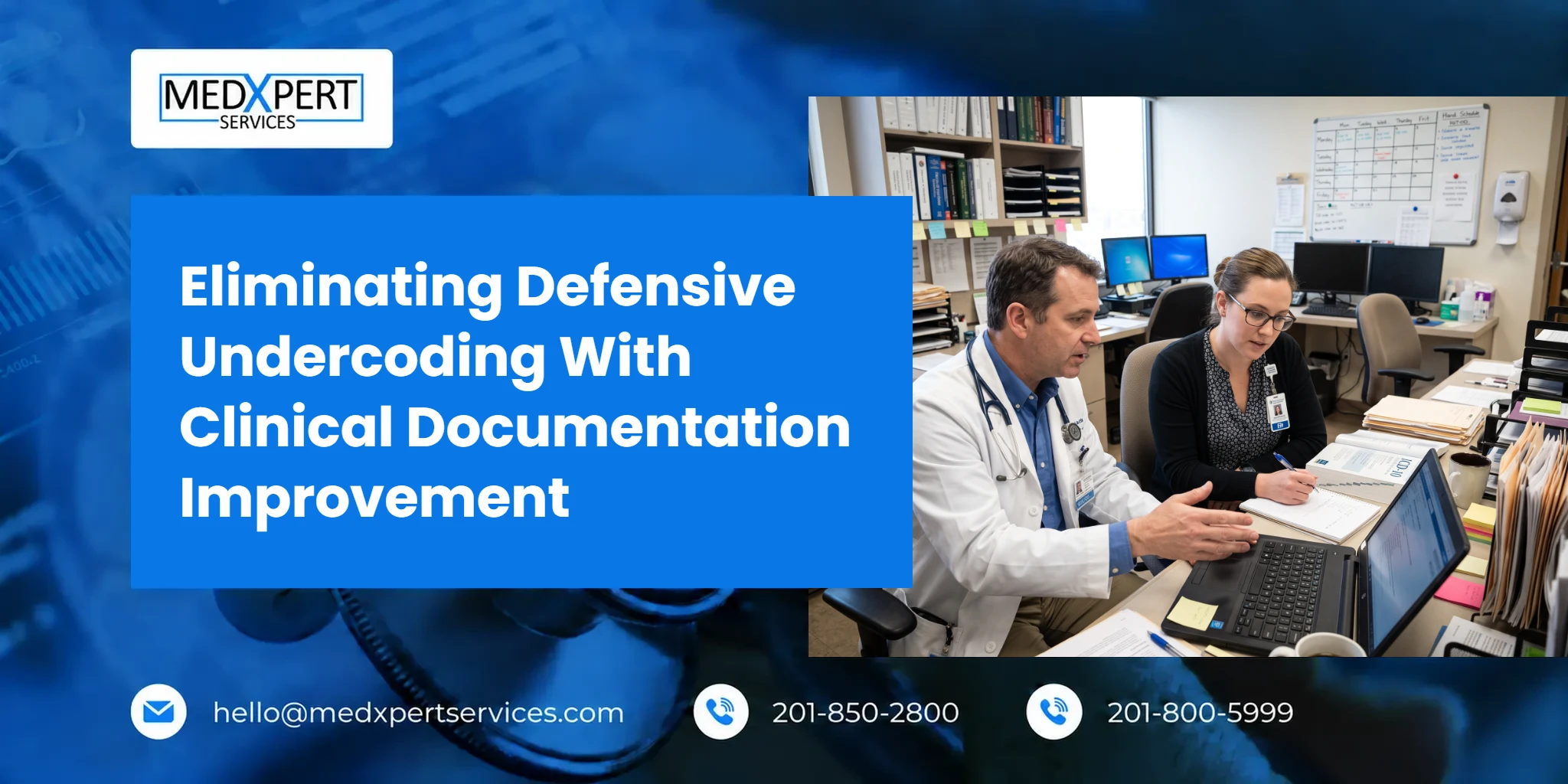
Clinical documentation improvement stops defensive undercoding by making the note show the work the physician actually did. Defensive undercoding happens when a provider picks a lower E/M level than the visit supports, for example to avoid an audit or because charting the full picture takes too long. A focused CDI program fixes both causes: it makes complete documentation faster and makes the correct level easier to defend.
This guide is for medical directors, high-volume clinic owners and compliance managers. It explains where defensive undercoding revenue loss comes from, how Medical Decision Making (MDM) complexity levels work under the 2021 and 2023 E/M documentation guidelines, how ambient AI scribes and Certified Professional Coder (CPC) reviews fit together, and how to build a pre-bill query workflow.
Key Takeaways
- ✓
Undercoding is a documentation problem: Providers drop to a lower level when the note does not clearly show problems, data and risk.
- ✓
MDM sets the level: Since 2021 for office visits and 2023 for most other E/M settings, MDM or total time decides the code.
- ✓
AI scribes help, but do not code: Ambient tools draft the note; the provider still reviews it, and a coder still checks the level.
- ✓
Compliant queries close gaps: Non-leading pre-bill queries let providers clarify notes before claims go out.
- ✓
Audit both directions: CDI programs track undercoding and overcoding so levels match the work.
What Clinical Documentation Improvement Means for Defensive Undercoding
Defensive undercoding is the habit of billing a lower level than the documentation could support. For example, a physician may manage two chronic conditions and adjust a prescription, which can meet moderate MDM, but still bill 99213 instead of 99214. The reasons are familiar: fear of audits, unclear rules, and notes that leave out key details.
Clinical documentation improvement treats the cause instead of the code. In short, clinical documentation improvement against defensive undercoding teaches providers what each MDM element needs, gives them templates that capture it quickly, and adds a review step that catches gaps before billing. As a result, the level on the claim matches the work in the room.
The Financial Impact of Defensive Undercoding Revenue Loss
Defensive undercoding revenue loss is easy to miss because no payer denies the claim. Instead, each visit pays a little less than it should, and the gap repeats across every provider and every day. Over a year, a small shift in level distribution can add up to a large share of E/M revenue.
It also affects more than payment. Undercoded visits understate how sick the patient panel is, which can weaken risk adjustment in value-based contracts. In addition, a provider whose levels sit well below peers may look like an outlier in the other direction, which can draw questions of its own. Our article on how medical billing audits prevent revenue loss shows how to measure the gap in your own data.
Undercoding is not a safe choice either. Each claim should match the documentation, so a code below what the note supports is still an inaccurate claim. A steady pattern of it can raise compliance questions of its own, which is one more reason to fix the note instead of lowering the code.
Medical Decision Making (MDM) Complexity Levels
MDM has four levels: straightforward, low, moderate and high. Each level rests on three elements, and the visit must meet two of the three. The CMS E/M services guide explains that providers may also choose the level by total time on the date of the encounter instead of MDM.
| MDM level | Problems addressed | Data reviewed | Risk of management |
|---|---|---|---|
| Straightforward | One minimal problem | Minimal or none | Minimal |
| Low | One stable chronic illness, or one acute uncomplicated problem | Limited | Low, such as over-the-counter drugs |
| Moderate | Chronic illness with exacerbation, or two stable chronic illnesses | Moderate | Moderate, such as prescription drug management |
| High | Severe exacerbation, or a threat to life or bodily function | Extensive | High, such as a decision about hospitalization |
Most defensive undercoding happens at the line between low and moderate. A note that names each problem, states its status, lists the data reviewed and records the treatment decision makes that line clearer.
Time offers a second path. When a visit involves long counseling, care coordination or record review, the total time on the date of service may support a higher level than MDM. Clinical documentation improvement programs that fight defensive undercoding teach providers to record total time whenever it matters, because an unrecorded minute cannot support a code.
The 2021/2023 E/M Documentation Guidelines
The 2021/2023 E/M documentation guidelines changed what drives the level. In 2021, office and outpatient visits moved to MDM or total time, and history and exam stopped counting toward the level. Then, in 2023, most other E/M families, including hospital inpatient and observation, emergency department, nursing facility and home visits, adopted the same framework.
These changes removed the need for long histories and bulleted exams. Even so, older templates may still collect pages of history and exam while leaving out the details that now matter, such as the status of each problem and the reasoning behind the plan. Updating templates to the current guidelines is a practical first step.
Common Documentation Gaps Behind Defensive Undercoding
Clinical documentation improvement against defensive undercoding starts by finding the gaps that push providers toward a lower level. Look for these patterns:
- Problems listed without their status, such as “diabetes” instead of “diabetes, A1C above goal.”
- Data the provider reviewed but never mentioned, such as outside records or imaging reports.
- Treatment decisions written as “continue meds” without naming the drug or the change.
- Copied text from earlier visits that buries what happened today.
- Time spent on the date of service that nobody recorded, even when time would support a higher level.
Each gap has a simple fix in the template or in provider habits. For a refresher on how providers support a common level, see our guide to CPT 99213.
Ambient AI Scribe EHR Integration for Clinical Documentation Improvement
Ambient AI scribes record the visit conversation and draft a note in the EHR for the provider to review. Good ambient AI scribe EHR integration can cut charting time and capture details providers may skip, such as the data they reviewed and the options they discussed. However, the tool does not choose the code, and the provider remains responsible for the final note.
- Confirm patient consent and recording rules that apply in your state.
- Require providers to review and edit every draft before signing.
- Map the draft to sections that match the three MDM elements.
- Spot-check AI-drafted notes for errors, copied text and missing assessments.
Certified Professional Coder (CPC) Chart Scrubbing Against Defensive Undercoding
Certified Professional Coder (CPC) chart scrubbing adds a trained human review before claims go out. A coder compares the documented MDM with the selected level and flags both undercoding and overcoding. Together with AI-drafted notes, this review captures the full clinical picture without adding much time for the provider.
To keep reviews efficient, target them. Review every new provider’s notes for the first months, a sample of each provider’s visits each quarter, and any visit type where levels shift suddenly. Feed the results back to providers with real examples from their own notes. Short, specific feedback changes habits faster than general training sessions.
Pre-Bill Query Workflow Optimization
Pre-bill query workflow optimization means asking providers clear questions before the claim leaves, not after a payer audit. The AHIMA and ACDIS guidelines for a compliant query practice set the standard: queries must be non-leading, must present the clinical facts, and must not suggest a payment impact.
- Trigger: A coder or CDI specialist finds a gap, such as a problem with no stated status.
- Query: The reviewer sends a short, non-leading question with the relevant facts from the note.
- Response: The provider answers and, if appropriate, adds an addendum.
- Code: The coder selects the level from the final documentation.
- Track: The team logs query topics to target future education.
Set a short turnaround so claims do not stall. Specific questions are also quicker for providers to answer.
Payer Downcoding vs. Defensive Undercoding
Defensive undercoding starts inside the practice, when a provider picks a lower level than the note supports. Payer downcoding starts after submission, when the plan pays a lower level than the one billed. Both cut revenue on claims that look paid, so neither one shows up on a denial report.
Clinical documentation improvement helps with both. A complete note lets coders bill the right level, and it also gives you evidence when you appeal a payer change. To catch payer downcoding, compare the billed code with the paid code on each remittance and track the pattern by payer and provider. In addition, watch for cloned notes, since copied text weakens the record in both cases.
Example: Fixing Defensive Undercoding in a Primary Care Clinic
A hypothetical primary care group notices that its providers bill most established visits as 99213, even for patients with several chronic conditions. A CPC review of a sample finds that many notes support 99214 but list problems without their status. The group updates its templates, adds an ambient scribe pilot for two providers and starts pre-bill queries for unclear notes. Three months later, the level mix reflects the documented work, and audits show no increase in overcoding.
Building a Clinical Documentation Improvement Program Against Defensive Undercoding
A lasting program combines education, tools and review. Start with a baseline audit of level distribution by provider. Next, update templates to the current guidelines and train providers on the three MDM elements. Then add CPC review and pre-bill queries, and decide whether an ambient scribe pilot fits your clinic. Finally, repeat the audit every quarter so improvements stick.
Track a few simple measures to show progress: the level distribution by provider, the share of visits with a query, the query response time and audit agreement rates. In addition, compare each provider with their own history, since patient mix changes what a normal distribution looks like.
Throughout, measure accuracy, not just revenue. The goal of clinical documentation improvement against defensive undercoding is a level on every claim that the note clearly supports, which protects revenue and reduces audit risk at the same time. For audit-specific risk, see our guide to the Medicare TPE audit process.
Ready to eliminate documentation bottlenecks without risking compliance? Work with our medical billing and coding audit services team to optimize your E/M coding accuracy and maximize practice reimbursement.