



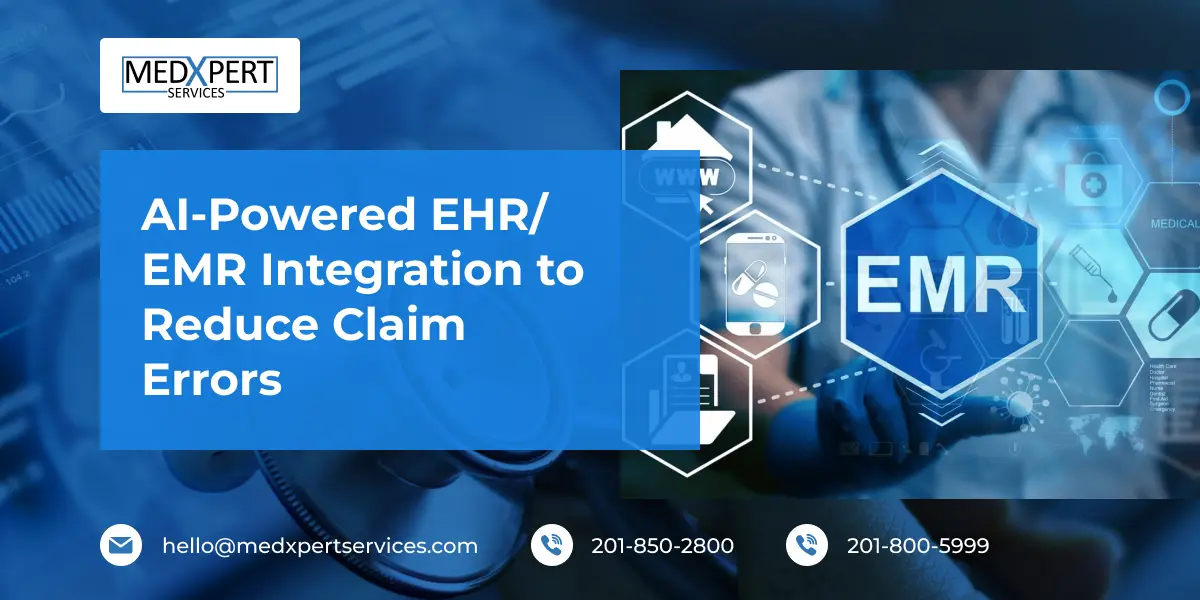
Do your claim errors impact your reimbursements and increasing administrative workload? AI-Powered EHR/EMR Integration uses Electronic Health Records (EHRs), Natural Language Processing (NLP), and predictive intelligence to detect documentation and coding errors before claims are submitted.
Natural Language Processing (NLP) can extract useful information from physician notes, discharge summaries, operation reports, and other unstructured clinical records. It helps to improve documentation and billing accuracy. The importance of interoperable, AI-ready health information systems is growing.
CMS has also finalized 2026 updates to the Medicare Promoting Interoperability Program, including a 180-day EHR reporting period and strengthened security risk management and EHR resilience requirements.
This guide explains how AI-Powered EHR/EMR Integration works, how NLP interprets clinical documentation, and how predictive intelligence helps reduce medical claim errors.
Know More About AI-Powered EHR/EMR Integration?
AI-Powered EHR/EMR Integration integrates artificial intelligence with Electronic Health Records (EHRs) and Electronic Medical Records (EMRs) to improve clinical documentation, coding, and billing precision. This section describes how AI, NLP, and predictive intelligence assist healthcare providers and revenue cycle teams in reducing medical claim errors.
How AI Enhances Traditional EHR and EMR Systems
Traditional EHR and EMR systems primarily store patient information, document encounters, and support clinical workflows. AI-Powered EHR/EMR Integration expands these functions by analyzing structured and unstructured clinical data to identify missing information, coding inconsistencies, and documentation gaps before claims are submitted. NLP reviews physician notes, discharge summaries, operative reports, and diagnostic reports to extract clinical details that support accurate coding.
AI also assists healthcare teams by:
1. Identifying incomplete clinical documentation.
2. Suggesting relevant ICD-10-CM diagnosis codes based on documented conditions.
3. Supporting CPT and HCPCS code selection using documented procedures.
4. Detecting documentation inconsistencies that may increase denial risk.
5. Alerting staff to potential payer edits before claim submission.
Core Components of AI-Powered EHR/EMR Integration
Several technologies work together to improve documentation quality and claim accuracy.
Natural Language Processing (NLP): Extracts clinical information from free-text documentation such as physician notes and discharge summaries.
Machine Learning: Reviews historical clinical and billing data to identify recurring documentation and coding patterns.
Predictive Intelligence: Detects claims with a higher likelihood of denial by identifying missing documentation, coding issues, or payer-specific risks.
Clinical Decision Support (CDS): Provides documentation prompts that help providers record complete and clinically relevant information.
Data Integration: Combines clinical, administrative, laboratory, imaging, and billing data into a unified workflow, supporting more accurate coding and reimbursement decisions.
Understanding NLP in Healthcare
Natural Language Processing (NLP) helps healthcare systems convert unstructured clinical documentation into usable data for coding, billing, and patient care. This section explains how NLP in Healthcare supports AI-Powered EHR/EMR Integration and improves claim accuracy.
What Is Natural Language Processing?
(NLP) is a branch of artificial intelligence that enables computers to understand, organize, and interpret human language. In healthcare, NLP analyzes clinical documentation recorded in Electronic Health Records (EHRs) and Electronic Medical Records (EMRs), converting free-text information into structured data that supports coding, billing, and clinical decision-making.
Instead of relying only on manually entered fields, NLP identifies important clinical details from provider documentation. This improves documentation quality and helps billing teams capture complete and accurate information before claims are submitted.
How NLP Reads Clinical Notes
Healthcare providers record valuable clinical information in narrative documents that standard EHR fields cannot fully capture. NLP reviews these records and identifies diagnoses, procedures, medications, symptoms, and other clinical concepts that support accurate coding.
Common documents analyzed by NLP include:
- Physician progress notes
- Operative reports
- Discharge summaries
- Radiology reports
- Pathology reports
- Consultation notes
- Emergency department documentation
NLP Applications in Medical Billing
NLP plays an important role in AI in Medical Billing by supporting documentation accuracy before the coding process begins. It helps medical billers, certified coders, and revenue cycle teams identify information that affects reimbursement while reducing manual review.
Key applications include:
- Extracting diagnoses for ICD-10-CM coding.
- Identifying documented procedures for CPT and HCPCS code selection.
- Detecting incomplete or inconsistent clinical documentation.
- Supporting Clinical Documentation Improvement (CDI) programs.
- Identifying documentation gaps that may increase the risk of claim denials.
- Assisting coding teams with documentation review before claim submission.
How AI-Powered EHR/EMR Integration Reduces Medical Claim Errors
Medical claim errors often result from incomplete documentation, coding inconsistencies, and missed payer requirements. AI-Powered EHR/EMR Integration uses NLP and predictive intelligence to identify these issues before claims are submitted.
AI-Assisted Clinical Documentation
AI reviews clinical documentation as providers record patient encounters and identifies missing or inconsistent information that may affect coding and reimbursement. NLP converts free-text physician notes into structured data, making documentation easier to review and supporting more accurate medical records.
More complete documentation supports correct ICD-10-CM, CPT, and HCPCS code selection while reducing documentation-related claim errors. Certified medical coders and healthcare providers still verify all documentation before claims are submitted to maintain coding accuracy and compliance.
Intelligent ICD-10-CM, CPT, and HCPCS Coding Support
AI-Powered EHR/EMR Integration compares documented diagnoses, procedures, and services with coding guidelines to support accurate ICD-10-CM, CPT, and HCPCS code selection. It can identify missing documentation, coding mismatches, and potential modifier issues before claims are generated.
This review helps medical coders and billing specialists reduce manual coding errors and improve claim quality. Final code assignment remains the responsibility of certified coders and qualified healthcare professionals, ensuring compliance with payer policies and official coding standards.
Predictive Claim Validation and Denial Prevention
Predictive intelligence reviews historical billing patterns, payer edits, and documentation quality to identify claims that may be denied. It alerts billing teams to correct potential issues before submission, reducing preventable errors and rework.
AI can help identify:
1. Missing clinical documentation.
2. Incorrect or incomplete diagnosis codes.
3. Procedure and modifier inconsistencies.
4. Medical necessity concerns.
5. Duplicate claim submissions.
6. Eligibility or insurance coverage issues.
7. Missing prior authorization requirements.
Benefits of AI in Medical Billing
AI in Medical Billing helps healthcare organizations improve documentation quality, coding accuracy, and claim processing while reducing preventable billing errors. This section explains the key benefits of AI-powered billing workflows for providers, coders, practice managers, and revenue cycle teams.
Better Coding Accuracy
AI reviews clinical documentation and compares it with ICD-10-CM, CPT, and HCPCS coding guidelines to identify missing or inconsistent information. This supports certified coders in selecting accurate codes while reducing documentation-related coding errors.
Higher Clean Claim Rate
AI identifies documentation gaps, coding inconsistencies, and payer-specific edits before claims are submitted. Correcting these issues early increases the likelihood that claims are accepted on the first submission.
Lower Denial Rates
Predictive intelligence identifies claims with a higher risk of denial by reviewing historical billing patterns and payer requirements. Billing teams can resolve potential issues before submission, reducing avoidable denials and rework.
Faster Reimbursement
Accurate documentation and cleaner claims reduce claim corrections and resubmissions. This shortens payment turnaround times and supports more consistent cash flow for healthcare organizations.
Reduced Administrative Work
AI assists with documentation review, coding support, and claim validation, allowing billing and coding teams to spend less time on repetitive manual tasks. Staff can focus more on complex claims, compliance reviews, and patient-related activities.
Better Compliance Monitoring
AI continuously reviews documentation and coding against payer policies and recognized coding standards. It helps identify potential compliance risks while supporting accurate billing, audit readiness, and adherence to CMS and HIPAA documentation requirements.
Conclusion
AI-Powered EHR/EMR Integration is changing how healthcare organizations manage clinical documentation, coding, and medical billing. By combining NLP in Healthcare with Predictive Intelligence for Claim Accuracy, providers can identify documentation gaps early, improve coding precision, and reduce medical claim errors before submission.
While AI supports faster documentation review and more accurate billing workflows, it does not replace certified medical coders, healthcare providers, or compliance professionals. Human expertise remains essential to validate coding decisions, maintain regulatory compliance, and ensure accurate reimbursement.
As healthcare organizations continue adopting AI-enabled technologies, integrating intelligent EHR/EMR systems with strong documentation practices and qualified oversight can improve clean claim rates, reduce denials, and strengthen overall revenue cycle performance.
FAQs
What is AI-Powered EHR/EMR Integration?
AI-Powered EHR/EMR Integration combines artificial intelligence with Electronic Health Records (EHRs) and Electronic Medical Records (EMRs) to improve clinical documentation, coding accuracy, and medical billing. It helps identify documentation and coding issues before claims are submitted.
How does NLP improve medical billing accuracy?
Natural Language Processing (NLP) analyzes physician notes, discharge summaries, and other clinical records to extract structured information. This supports accurate ICD-10-CM, CPT®, and HCPCS coding while reducing documentation-related claim errors.
How does predictive intelligence help reduce medical claim errors?
Predictive intelligence reviews historical billing patterns, payer rules, and documentation quality to identify claims with a higher risk of denial. It alerts billing teams to correct potential issues before claim submission.
Can AI replace medical coders and billing specialists?
No. AI supports documentation review, coding suggestions, and claim validation, but certified medical coders and healthcare professionals remain responsible for assigning final codes, ensuring compliance, and validating claim accuracy.
What are the main benefits of AI-Powered EHR/EMR Integration?
AI-Powered EHR/EMR Integration improves documentation quality, supports coding accuracy, increases clean claim rates, reduces claim denials, shortens reimbursement cycles, and helps healthcare organizations maintain compliance with payer and regulatory requirements.